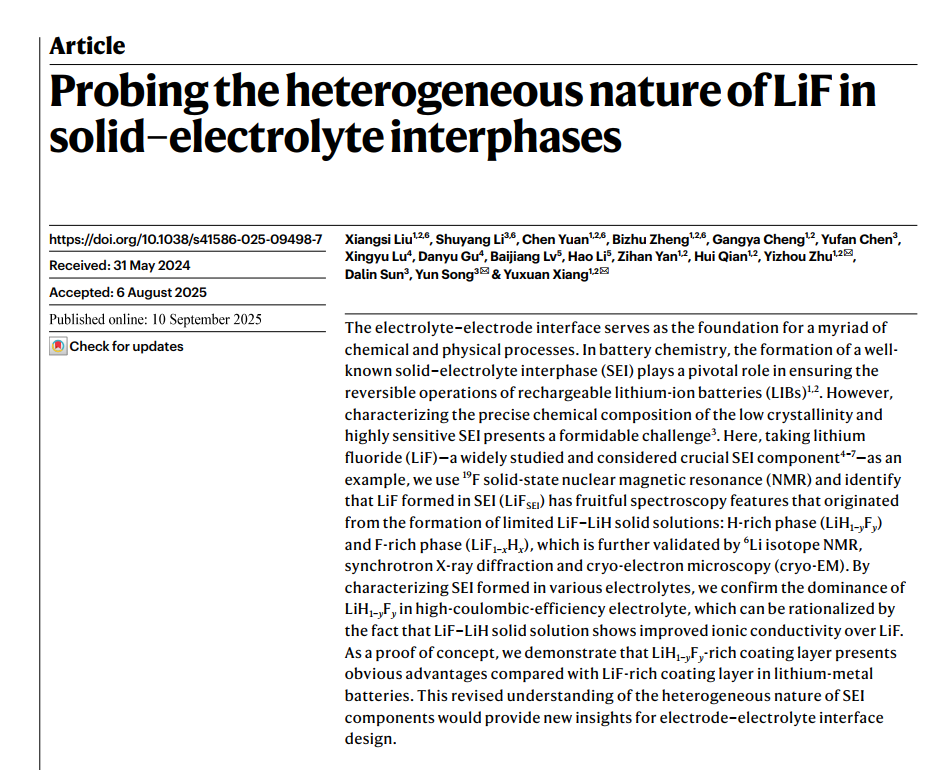
Focusing on lithium fluoride (LiF), a key substance in the interphase, our teams employed multi-nuclear and multi-dimensional solid-state nuclear magnetic resonance (SS NMR) spectroscopy. We discovered that LiF in high-performance lithium-ion batteries does not exist as a pure phase. Instead, it primarily embeds within the SEI as an LiF-LiH solid solution. This conclusion was robustly verified using multiple techniques, including6Li isotope SS NMR, synchrotron X-ray diffraction (XRD), and cryogenic electron microscopy (cryo-EM).
Further research revealed that in electrolyte systems exhibiting high Coulombic efficiency, a hydrogen-rich phase (LiH1-yFy) solid solution dominates the SEI. Compared to pure-phase LiF, the LiH1-yFysolid solution demonstrates significantly higher lithium-ion conductivity, making it a crucial component for enabling fast charging and discharging. As a proof of concept, the team constructed an LiH1-yFycoating layer and conducted comparative tests in lithium metal batteries. The results showed that its performance was markedly superior to traditional LiF coating layer.
This work introduces the new concept of "heterogeneity in SEI components," challenging the long-standing view that interphase components exist as pure phases. It provides essential theoretical guidance for designing high-performance electrolytes and electrode interphase materials. Our work was published in the journal Nature under the title "Probing the Heterogeneous Nature of LiF in Solid-Electrolyte Interphases."